Beyond the Copilot: Agentic AI Across the Software Development Lifecycle
At ALIGN New York City 2026, KMS Technology CTO Guy Merritt shared how his team built a role-based agentic platform for software delivery, with tiered agents, deterministic workflows and layered guardrails.
By The AI Enterprise Magazine Team3 min read
Key takeaways
- Code is the smallest piece. Requirements, testing, reviews and governance are where agents can add the most.
- Use the right model for the job. KMS routes work across 400+ models because clients and tasks differ.
- Tier your agents. Role agents, narrow subagents and one tool agent per tool keep control.
- Workflows make AI predictable. They detect problems and pause for human help.
- Keep guardrails. Like firewalls, they are imperfect but still necessary.
- Measure time, not savings. KMS reports 50 to 75 percent faster development.
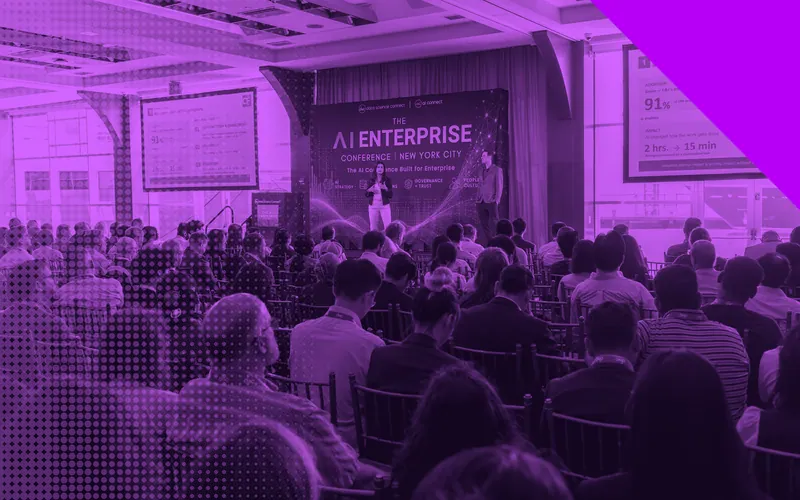
Code generation is no longer the hard part of building software. According to Guy Merritt, Chief Technology Officer at KMS Technology, the real opportunity for agentic AI is everything around the code: requirements, testing, reviews, controls, governance and integration. Merritt spoke at the ALIGN AI Executive Summit New York City 2026 on June 25, in a session sponsored by KMS Technology titled Beyond the Copilot: Orchestrating Agentic AI Across the Software Development Lifecycle.
Why isn't code generation enough?
KMS Technology is an engineering services provider, and Merritt said its industry exists because there were once not enough coders. "That problem is now solved," he said. Today's code generation tools do a good job, but in production work, generating code is the smallest piece.
Merritt said the biggest gaps sit elsewhere. Teams need ways to validate that requirements are correct, to generate test cases automatically from those requirements, and to keep human review and approval built into the workflow. KMS has spent about four years building an internal agentic platform for its own delivery teams to work on these problems, and Merritt said the company is sharing the blueprint publicly.
How is the platform designed?
Clients don't all approve the same models, and some models are better at certain kinds of code than others. So the platform connects to more than 400 models through OpenRouter and uses the right model for each job.
The platform does not generate code itself. Instead, it wraps around whichever code generation tool a team prefers and orchestrates the work of everyone on a project: project managers, business analysts, product managers, architects, developers, testers and DevOps. Agents are role-based, and each role maps to a workflow. A knowledge hub that aggregates information across the whole software project became, he said, "vitally important." Merritt added that about 70 percent of the design is generic and can be applied outside software delivery.
How should agents be organized?
KMS does not use one-size-fits-all agents. Its design has three tiers:
- Main agents organized around roles, such as QA, risk manager, business analyst and developer.
- Subagents that do narrow, deep, programmatic tasks.
- Tool agents, one per tool, so models never call tools directly. Subagents can't reach tool agents either, which keeps role agents aware of everything in their workflow.
Every agent follows a standard pattern so it inherits the system's guardrails, and once in production it must be registered and its behavior logged. "Guardrails is more than just software you wrap around the agent," Merritt said. It is an architectural design pattern, and he argued that the agent hierarchy and workflows are both forms of guardrails.
Why are workflows the future of applications?
A language model is probabilistic, Merritt said, but "when you're in the enterprise, we must be predictable." Workflows provide that predictability. They keep control of the system, detect when something goes wrong and know when to pause and ask the team for help. He described the future of enterprise applications as connected workflows that control their agents.
Guardrails still matter even when they aren't sufficient on their own. Merritt compared them to firewalls: they get penetrated, but no one throws them away. KMS validates both what goes into an agent and what comes out. It also minimizes human prompting, letting agents use programmatic prompts for more predictable output.
What about outputs and context?
Merritt said teams should design outputs around how users will consume them, with streaming for near-real-time information and batch for results that need full analysis. Context matters both coming in, such as Jira tickets, and going out, since teams need to be careful about how information leaves an agentic system.
What results is KMS seeing?
Merritt avoids talking about cost savings, because AI and token costs complicate the math. Time to delivery is the clearer measure. He said KMS is seeing 50 to 75 percent reductions in development time compared with traditional engineering, while calling these early results. After decades of hype cycles, he said, applying agentic AI to software engineering "is not hype."
Where to hear more in 2027
Engineering and AI leaders will keep comparing notes at the 2027 ALIGN AI Executive Summits, invitation-only gatherings in eight U.S. cities: Atlanta, New York City, Dallas, Chicago, San Francisco, Boston, DC and Los Angeles. Registration is coming soon. See the ALIGN AI Executive Summits page.
Frequently asked questions
How can agentic AI help beyond code generation?
By validating requirements, generating test cases, and orchestrating role-based work with human approvals built into workflows.
What is a tiered agent hierarchy?
Main agents organized by role, specialized subagents for narrow tasks, and one tool agent per tool so models don't call tools directly.
What results has KMS Technology seen?
Merritt said KMS sees 50 to 75 percent reductions in development time compared with traditional engineering, calling them early results.
This article is based on remarks by Guy Merritt, CTO, KMS Technology at ALIGN AI Executive Summit New York City 2026 on June 25, 2026. More coverage: ALIGN AI Executive Summits.
Filed under: Agentic AI, AI Governance & Trust, AI Strategy & ROI