
AI Agents in the Enterprise: Hype, Reality and Risk
At ALIGN New York City 2026, leaders from Synchrony, Alteryx and Evernorth Health Services compared notes on bounded agents, the work it takes to make them reliable, and how to approach memory, tool orchestration and observability.
By The AI Enterprise Magazine Team4 min read

Key takeaways
- Bound the agent. Tie each agent to a specific task, procedure and definition of success.
- Context comes first. Without enterprise context, captured in knowledge graphs and ontologies, agents fail.
- Expect real build time. Alteryx spent six months building a rules engine its agents consult when work fails.
- Layer memory. Session, business process and global memory, each auditable and time bounded.
- Keep orchestration deterministic. Run tool sequencing outside the model and give agents fewer tools.
- Trace decisions. Anything documented today must still be documented and reviewed when agents do the work.
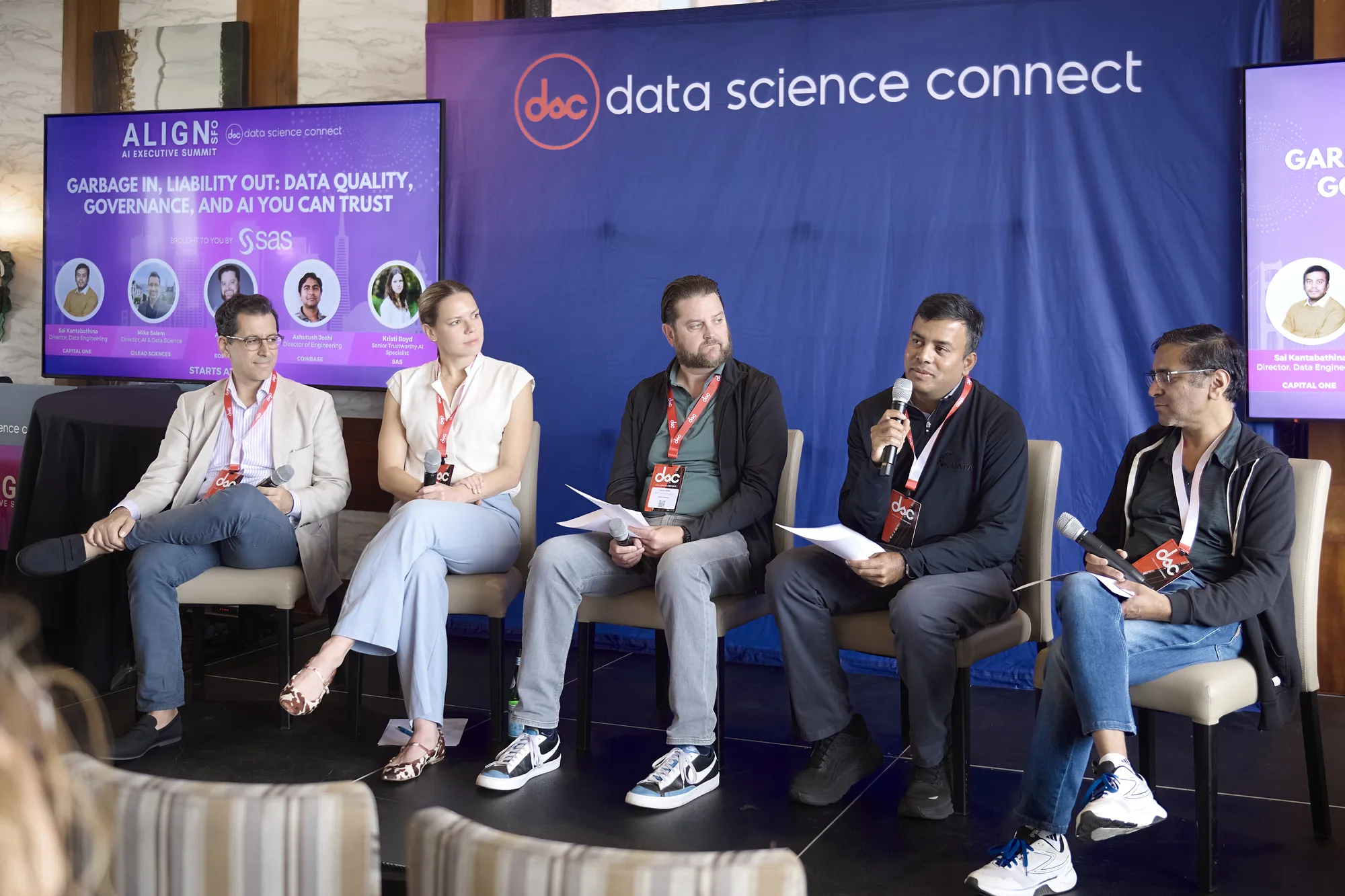
Enterprise AI agents work best when they have a clear goal, a bounded context and access to trusted data, and they still need a lot of human-built scaffolding to get there. That was the consensus of a lunchtime panel at the ALIGN AI Executive Summit New York City 2026 on June 25, Agents in the Enterprise: Hype, Reality, and Risk, brought to you by Alteryx. Panelists included Nasim Khoshkhou, SVP, Analytics and Data at Synchrony; Joshua Burkhow, Chief Evangelist at Alteryx; and Narasimha Bingi, Head of Architecture for Digital, Data, and AI at Evernorth Health Services. Panelists spoke for themselves, not their employers.
What separates an enterprise agent from a script or a copilot?
Khoshkhou said an agent is given some room to reason, but not unlimited room, and usually handles one piece of a process that is repeatable yet "could be slightly different each time." Bingi added that agents need a bounded context, much like microservices. In claims adjudication, for example, he said teams should tie each agent to a specific task and standard operating procedure so it knows what success looks like.
Burkhow described two realizations most people have with AI: first that it is more powerful than they expected, then that it cannot do everything. The sooner teams reach the second, he said, the sooner they see that decades of data warehousing and data management principles "still apply."
Where are agents delivering value today?
Khoshkhou's team uses agents to break down agile work, translating requirements into user stories, then into code and tests. The result is more consistent, better-documented stories, with product owners and scrum masters still reviewing the output. Bingi pointed to claims triage and AI voice agents in customer service, noting that latency that was once around two seconds has dropped to a level that works for customers. His organization runs voice agents in production on Sierra.
Burkhow argued that a less visible benefit is capacity. Many employees are running at 120 percent, he said, and agents that bring that down give them room to think and be creative.
Why do agents break down?
Bingi's first two reasons were a missing goal and missing context. Much enterprise context lives in people's heads, he said, and needs to be captured in knowledge graphs and ontologies. "Do not go into agentic architecture if you think that you do not have enough context," he said.
Burkhow described spending six months teaching agents to build Alteryx workflows. Early attempts placed tools without connecting or configuring them. His team built a rules engine of 250 to 300 rules the agents consult when something fails, and he now has a team of agents running for hours to build more than a thousand workflows. He also suggested teams accept imperfection: "You could go and make meaningful progress by just getting 50 percent better."
Khoshkhou said the hardest part is upstream. "If you don't know your own process, how are you going to train AI?"
How should teams think about agent memory?
Bingi proposed three layers, session, business process and global memory, each well defined, time bounded and auditable. Khoshkhou compared shared memory to shared code: common KPI definitions should be reused, while exploratory or partner-specific work should not be stored. Coming from banking, she noted that decisions related to fair lending and fraud must be documented far longer than typical short-term memory windows.
Burkhow said the bigger problem is reliability. Even when rules are available and agents are told to follow them, "sometimes it just decides to go do what it does."
Who should orchestrate the tools?
Burkhow argued that, for now, orchestration should sit outside the language model in deterministic software, which in Alteryx One takes the form of a "workflow of workflows." Bingi recommended pushing business logic down into APIs and data services so agents route work rather than carry logic. The panel agreed that fewer tools per agent is better.
What does useful observability look like?
Bingi focused on decision traces, both for regulatory audit and so a separate agent can certify another agent's work. Khoshkhou said anything documented today must still be documented when agents take it on, and reviewed. Burkhow noted that no one can fully explain how a model produces an answer, so teams need scaffolding that records prompts, tool access, data and decisions.
In a closing lightning round, the advice was to understand your process, be clear on what actually needs AI, and start with a high-value, well-defined problem.
Where to hear more in 2027
Enterprise leaders will keep comparing notes on agents at the 2027 ALIGN AI Executive Summits, invitation-only gatherings in eight U.S. cities: Atlanta, New York City, Dallas, Chicago, San Francisco, Boston, DC and Los Angeles. Registration is coming soon. See the ALIGN AI Executive Summits page.
Frequently asked questions
What makes an AI agent enterprise grade?
Panelists pointed to a clear goal, bounded context, access to trusted, governed data, and human oversight.
Where are AI agents delivering value today?
Examples included turning requirements into user stories and tests, claims triage, and AI voice agents for customer service.
How should enterprises manage agent memory?
One approach is three layers, session, business process and global memory, each defined, time bounded and auditable.
This article is based on remarks by Nasim Khoshkhou, SVP, Analytics and Data, Synchrony; Joshua Burkhow, Chief Evangelist, Alteryx; Narasimha Bingi, Head of Architecture - Digital, Data, and AI, Evernorth Health Services at ALIGN AI Executive Summit New York City 2026 on June 25, 2026. More coverage: ALIGN AI Executive Summits.
Filed under: Agentic AI, AI Governance & Trust, Observability & Data Quality