
Context Engineering in the Enterprise: Making AI Actually Useful
At ALIGN Chicago 2026, data and AI leaders from healthcare, public safety technology, research and social media discussed why business context is the real differentiator for enterprise AI and how to build, protect and evaluate it.
By The AI Enterprise Magazine Team4 min read

Key takeaways
- Context lives with experts. Business meaning is often held by a few people and must be captured.
- Gate by ownership. Curated datasets with assigned business owners come before chat-with-data.
- Less can be more. Overloaded context windows can reduce accuracy.
- Classify sensitive data. Focus effort on regulatory, IP and financial data.
- Evaluate context separately. Use accuracy, completeness, timeliness and uniqueness.
- Match rigor to risk. Ship low-risk uses fast; make financial answers exact.
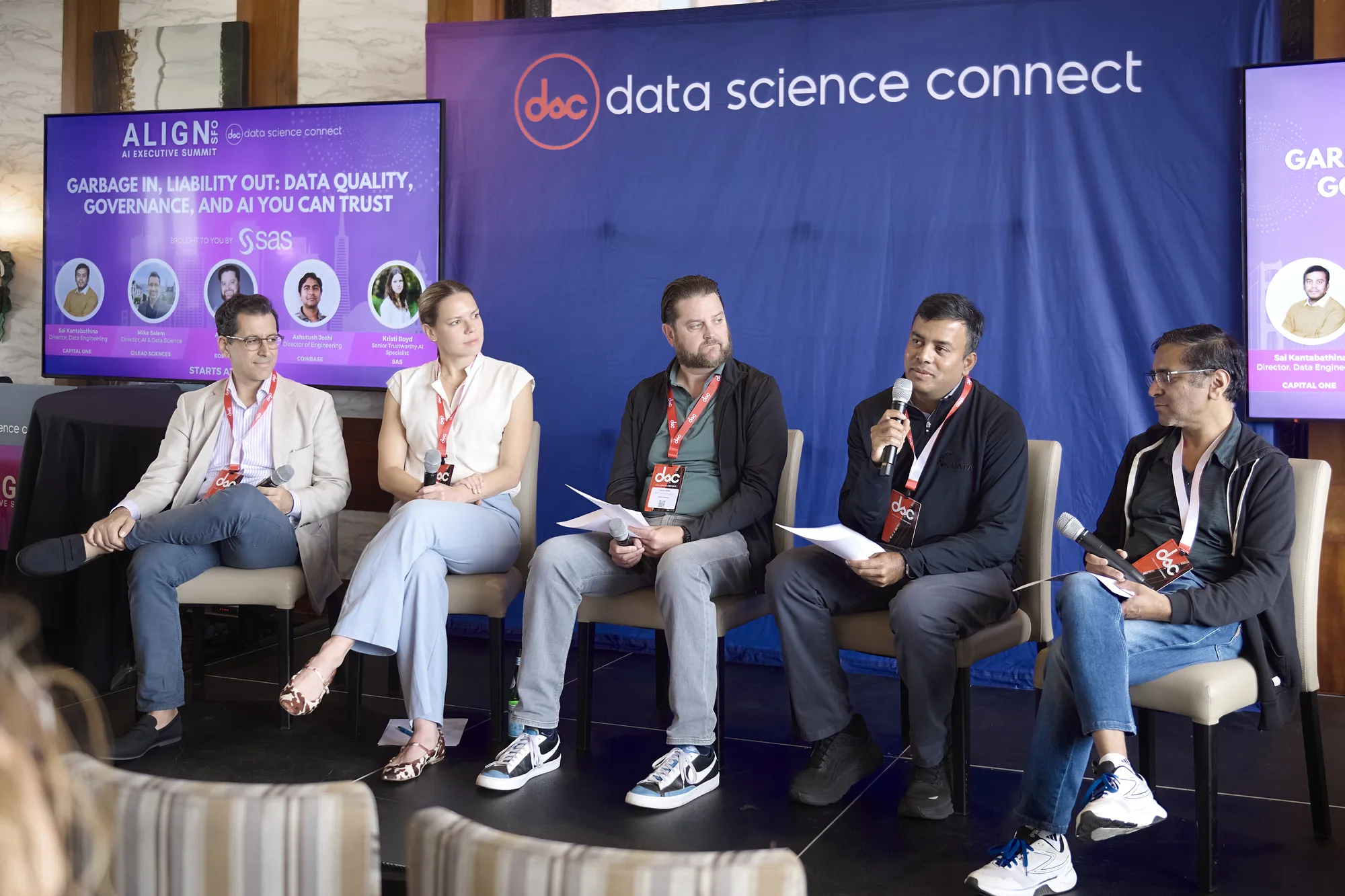
Models are increasingly interchangeable. What makes enterprise AI useful is whether it knows enough about the specific situation, and that knowledge often lives in the heads of a few subject matter experts. That was the starting point for an afternoon panel at the ALIGN AI Executive Summit Chicago 2026 on July 15, Context Engineering in the Enterprise: RAG, MCP, and Making AI Actually Useful. Palak Shah, Privacy Policy Director at Meta, moderated. Panelists were Rajkamal Gopinath, Director of Data Software Engineering for R&D at Abbott; Prakash Rao, who leads digital strategy for Medtronic's cardiac rhythm management business; Elena Garvey, IT Director of Enterprise Data Intelligence at Motorola Solutions; and Elizabeth Johnson, Global Director of Data Integrity and Strategic Governance at Ipsos. Panelists spoke for themselves, not their employers.
Shah defined context engineering as building systems that pull the right documents, data and history at the right moment, and added that it is just as important to be intentional about what to leave out.
Where does context break down?
Gopinath pointed to data silos: data used for inference must be enriched and curated, and organizations that haven't built a knowledge layer need to invest in one. Rao described silos inside a large medical device company and outside it, where hospitals combine data from electronic medical records, devices, labs and pharmacy systems that don't communicate well.
Garvey distinguished technical metadata from business context, the part that makes data interpretable. Context breaks down, she said, because "it's in the mind of your subject matter expert." Johnson gave an example from Ipsos: a model that worked well on survey data kept choosing the wrong weighting because it didn't know which clients used which weighting conventions.
How are teams building context into the architecture?
Garvey's team was preparing to launch an enterprise chat-with-data agent built on two MCP connections, one to the enterprise data warehouse and one to its data catalog. Access is gated: a dataset must be curated and have business data owners assigned to maintain its metadata as it changes. She said the team chose a business-friendly catalog so privacy, audit and legal teams could tag and classify data themselves.
Johnson emphasized ownership and documentation, and said she wants to audit which context was supplied to a model separately from the answer it gave. Gopinath noted that more context isn't always better, since models can lose accuracy when the context window is too large, and said MCP can supply relevant context dynamically as well as perform actions. Rao said healthcare interoperability is improving as standards such as FHIR gain adoption, but the industry still lags others.
How do you keep sensitive data out of the wrong workflows?
Johnson called for explicit data classification, including categories like finance or HR data that AI shouldn't touch, or should touch only in specific ways, with permissions inherited carefully. Shah said de-identification and classification matter even more as AI pushes organizations toward using more data. Garvey argued against over-engineering: treat data as sensitive or not, and spend the effort on what is regulatory, IP or financial. Gopinath said governance is "really not a technology problem," but one of distributed ownership, policies and humans in the loop.
How do you measure whether context is working?
Rao measures outcomes: whether clinicians see more patients with higher quality and less paperwork, and whether product development timelines shrink. Gopinath said metrics should start from the business problem. Johnson evaluates context with data quality dimensions such as accuracy, completeness and timeliness, separately from the model. Garvey added uniqueness: "If you have five different definitions of revenue, you have zero definition."
What matters most going forward?
- Gopinath: There is no single universal context. Sometimes RAG is enough, and relationship questions may call for a knowledge graph.
- Rao: Interoperability, so systems can share the context being built.
- Garvey: Match effort to the business process. A CFO's financial questions need to be right every time, while lower-risk uses should ship and iterate. She said automated approaches never got past about 84 percent without business teams involved.
- Johnson: "Context you can't govern is context you can't trust." She treats context engineering as change management.
- Shah: Bring the people who will use the tools into the build.
Where to hear more in 2027
Data and AI leaders will keep comparing notes on context and governance at the 2027 ALIGN AI Executive Summits, invitation-only gatherings in eight U.S. cities: Atlanta, New York City, Dallas, Chicago, San Francisco, Boston, DC and Los Angeles. Registration is coming soon. See the ALIGN AI Executive Summits page.
Frequently asked questions
What is context engineering?
Building systems that give AI the right documents, data and history at the right moment, and deliberately excluding what it shouldn't use.
Why does enterprise AI lack context?
Panelists cited data silos and business meaning held by subject matter experts rather than documented in metadata.
How can teams evaluate context?
By measuring business outcomes and applying data quality dimensions such as accuracy, completeness, timeliness and uniqueness to the context itself.
This article is based on remarks by Palak Shah, Privacy Policy Director, Meta (moderator); Rajkamal Gopinath, Director, Data Software Engineering, R&D, Abbott; Prakash Rao, Digital Strategy, Cardiac Rhythm Management, Medtronic; Elena Garvey, IT Director, Enterprise Data Intelligence, Motorola Solutions; Elizabeth Johnson, Global Director, Data Integrity and Strategic Governance, Ipsos at ALIGN AI Executive Summit Chicago 2026 on July 15, 2026. More coverage: ALIGN AI Executive Summits.
Filed under: Context, Semantics & RAG, AI Governance & Trust, Data & AI Infrastructure